Mehrgarh and the People Who First Settled There
Mehrgarh, located on the Kachi Plain near the Bolan Pass in present-day Balochistan, Pakistan, is one of the most important archaeological sites for understanding the early history of settled life in South Asia. 1 Its position was especially significant because the Bolan Pass connected the plains of the Indus region with the highlands of Balochistan, the Iranian Plateau, and routes leading toward Central Asia. 2 Archaeologists began systematic excavations at Mehrgarh under the French Archaeological Mission and the Department of Archaeology of Pakistan in the 1970s, revealing houses, storage structures, workshops, burials, tools, ornaments, animal remains, and plant evidence. For many decades, Jean-François Jarrige and other scholars believed that the earliest occupation began around the eighth millennium BCE, and Mehrgarh consequently became famous as evidence for an exceptionally early and possibly independent South Asian farming tradition. 3 Recent scientific research, however, has changed this picture: radiocarbon dating of tooth enamel from twenty-three securely stratified burials indicates that the cemetery associated with Period I began approximately between 5200 and 4900 BCE and that the period probably lasted only a few centuries. 4 This does not make Mehrgarh less important; rather, it gives us a more precise understanding of when its agricultural community emerged. The people of Mehrgarh should therefore be understood not as an isolated population appearing suddenly in history, but as a community participating in the wider movements, exchanges, and transformations that connected South Asia with western and Central Asian regions.
From Mobile Life to Farming and Herding
The people of early Mehrgarh lived during a major transformation in human history: the gradual movement toward settled farming and herding. Archaeological evidence indicates that their economy combined cultivation, animal keeping, hunting, gathering, and the use of locally available natural resources rather than depending on agriculture alone. Wheat and barley were among the important cultivated plants, while sheep and goats formed part of the early herding economy, and cattle became increasingly important over time. 5 The precise origins of these domestic plants and animals remain a subject of scholarly debate. Earlier researchers, particularly Jarrige, emphasized local development and suggested that some agricultural practices and cattle domestication could have developed within South Asia, whereas more recent evidence favors the movement of farming communities or farming knowledge from regions farther west. 6 Genetic research on barley has also raised the possibility of an eastern centre of domestication somewhere beyond the Fertile Crescent, although Mehrgarh itself cannot yet be identified conclusively as that centre. 7 What seems increasingly clear is that the first farmers of Mehrgarh were not simply copying a complete agricultural “package”; farming developed through a complicated combination of introduced domesticates, local resources, hunting, experimentation, and adaptation. Their lives therefore represent a gradual negotiation between inherited knowledge and the particular environment of the Kachi Plain.
Houses, Buildings, and the Everyday Settlement
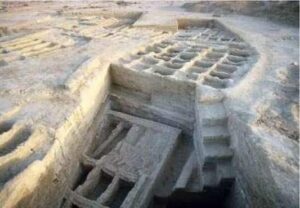
The physical remains of Mehrgarh allow us to imagine aspects of ordinary life more clearly than written records ever could, because no writing from this early period has survived. The inhabitants constructed buildings from hand-moulded mudbricks, often arranging them into rectangular structures divided into several rooms. Four-room plans were particularly common, while larger structures contained six or more compartments. 8 Some buildings appear to have been used for storage rather than ordinary domestic residence, and the presence of cereal remains and impressions has led archaeologists to connect certain compartmented structures with the storage and management of agricultural produce. Walls and floors could be plastered with clay, while traces of red colouring and geometric decoration show that the built environment was not simply functional but could also have been visually meaningful. Hearths, fire pits, grinding equipment, stone tools, and other remains indicate that food preparation, craft activities, and domestic work took place within and around the settlement. The settlement itself was not an unplanned collection of huts: buildings were arranged with open spaces and passages between them, and repeated construction over earlier structures shows that people returned to familiar places and rebuilt their homes. 9 In this sense, Mehrgarh was becoming a lived landscape in which houses, storage spaces, work areas, food production, and burial grounds were woven together into the everyday experience of the community.
Food, Animals, Hunting, and the Environment
Life at Mehrgarh was closely tied to the surrounding landscape, which offered a mixture of agricultural possibilities, grazing areas, riverine resources, and access to the mountains through the Bolan Pass. Archaeobotanical evidence shows the importance of barley and several varieties of wheat, while animal remains demonstrate that people maintained domestic herds but continued to hunt wild animals. 10 Wild sheep and goats, gazelle, deer, wild ass, boar, and other animals occur in the archaeological record, showing that the transition to farming did not mean an immediate abandonment of hunting. Cattle gradually became especially important, and evidence from Mehrgarh has played a major role in discussions about the domestication of South Asian zebu cattle. 11 The surrounding environment was also more varied than the image of an entirely barren landscape might suggest; archaeological and environmental studies have proposed the presence of riparian vegetation and wetter local conditions during parts of the occupation, although the environmental evidence remains limited. 12 People therefore lived within a landscape that could provide both cultivated food and wild resources. Their survival depended on flexibility: crops could be cultivated, animals herded, wild animals hunted, and natural materials collected or exchanged. This mixed economy helps explain why early Mehrgarh should be understood as a community of farmers and herders who still retained many practices associated with earlier hunting and gathering lifeways.
Crafts, Trade, Technology, and a Changing Culture
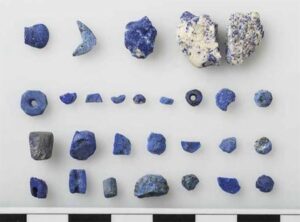
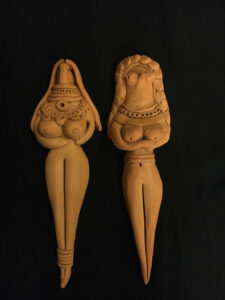
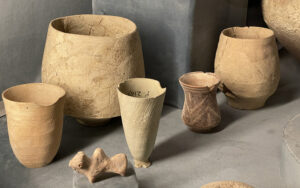
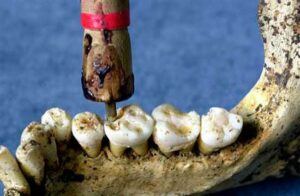
Mehrgarh was not simply a farming settlement; its inhabitants gradually developed specialized skills in stone working, bead production, pottery, ornament manufacture, and eventually metallurgy. Archaeologists have recovered beads and ornaments made from shell, steatite, turquoise, calcite, lapis lazuli, and other materials, some of which could not have originated immediately around the settlement. 13 Lapis lazuli is particularly important because its presence points toward connections extending toward regions of Afghanistan, while marine shell demonstrates contact with coastal areas. Such objects show that the people of Mehrgarh participated in networks of exchange long before the emergence of the urban Indus Civilization. The community also developed sophisticated knowledge of stone-tool production, including blades, trapezes, borers, scrapers, and other implements used in different kinds of work. 14 Copper objects appear in later Neolithic contexts, while pottery became an increasingly important part of material culture after the aceramic phase. New dating evidence indicates that pottery at Mehrgarh should not be placed as early as some older chronologies proposed; the earliest Period IIA ceramics now appear to belong no earlier than roughly the mid-fifth millennium BCE. 15 Another remarkable feature of Mehrgarh is the evidence for intentional dental modification, with drilled teeth demonstrating that people possessed specialized knowledge of dental intervention. 16 Together, these discoveries portray a society in which farming, craft production, experimentation, and long-distance exchange were already becoming interconnected aspects of daily life.
Burials, Beliefs, Identity, and Social Relationships
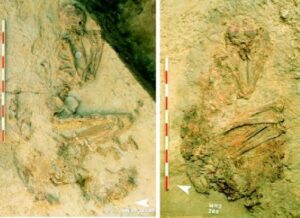
The cemeteries of Mehrgarh provide perhaps the most intimate evidence for how its people understood death, community, and personal identity. Archaeologists uncovered hundreds of burials, many of which were accompanied by objects such as beads, ornaments, tools, baskets, ochre, and occasionally animal remains. 17 Burial practices were not random: many graves followed recurring patterns of orientation, body position, grave construction, and the placement of objects, suggesting that the community possessed recognizable funerary traditions. Blanche Barthélemy de Saizieu’s detailed statistical studies showed that these traditions were remarkably stable in some respects while allowing considerable individual variation in the objects placed with the dead. 18 Particularly interesting is the changing relationship between ornaments and utilitarian objects: some individuals, especially children, could be richly ornamented, while a number of adults were associated more strongly with tools and practical equipment. These patterns may reflect differences of age, activity, identity, or social role, but they do not provide sufficient evidence for imposing a rigid system of social classes or hierarchy. 19 Red ochre, beads, shell, turquoise, stone tools, and other objects therefore seem to have carried meanings beyond their practical value, although the exact beliefs behind them remain unknown. The graves ultimately remind us that Mehrgarh was a community of individuals: people farmed and worked together, but they also expressed personal identity and relationships through the ways in which the dead were treated.
Mehrgarh’s Legacy and Its Place in South Asian History
The long-term importance of Mehrgarh lies not in a single invention but in the accumulation of many changes that helped shape the later history of South Asia. Its inhabitants established durable traditions of settled life, food production, animal management, mudbrick architecture, craft specialization, exchange, burial practice, and technological experimentation. Over subsequent periods, the settlement developed increasingly complex pottery traditions, craft production, storage practices, and connections with neighbouring regions, while sites such as Nausharo became important parts of the wider archaeological landscape. 20 Mehrgarh should not, however, be described simply as “the first Indus Civilization,” because the mature urban Indus Civilization emerged much later and possessed distinctive forms of cities, writing, craft organization, and social complexity. Instead, Mehrgarh represents one of the important earlier traditions from which later developments in the greater Indus region can be understood. The recent radiocarbon evidence has also made its history more interesting by showing that the earliest securely dated farming community at the site was younger than the chronology proposed by earlier excavators. 21 The story of Mehrgarh is consequently not a simple tale of an isolated village inventing civilization; it is the story of people adapting to a new landscape, combining farming with hunting and herding, building permanent homes, exchanging materials across long distances, developing crafts, caring for their dead, and gradually creating a social world that would become part of the deep background to later South Asian civilization. In the remains of their houses, tools, crops, animals, ornaments, and graves, we can therefore see not merely an archaeological “site,” but the traces of real communities whose everyday decisions helped transform the history of the region.
Further Reading
https://www.cambridge.org/core/books/cambridge-world-history/B9B4ACA699E9F94814D7C00EDB70D4A3
End Notes
- Cameron A. Petrie, “Mehrgarh, Pakistan,” in The Cambridge World History, edited by Graeme Barker and Candice Goucher (Cambridge: Cambridge University Press, 2015), 289-90.
- Cameron A. Petrie, “Mehrgarh, Pakistan,” in The Cambridge World History, edited by Graeme Barker and Candice Goucher (Cambridge: Cambridge University Press, 2015), 289-90.
- Jean-François Jarrige, “Mehrgarh Neolithic,” Pragdhara 18 (2008): 135–154; Jean-François Jarrige, “The Early Architectural Traditions of Greater Indus as Seen from Mehrgarh, Baluchistan,” Studies in the History of Art 31 (1993): 25–33.
- Benjamin Mutin et al., “New Radiocarbon Dates of Human Tooth Enamel Reveal a Late Appearance of Farming Life in the Indus Valley,” Scientific Reports 15 (2025): 11345, https://doi.org/10.1038/s41598-025-92621-5. The new Bayesian model places Mehrgarh Period I broadly between about 5250 and 4650 calibrated BCE, with the cemetery beginning most probably between 5200 and 4900 BCE.
- Benjamin Mutin et al., “New Radiocarbon Dates of Human Tooth Enamel Reveal a Late Appearance of Farming Life in the Indus Valley,” Scientific Reports 15 (2025): 11345, https://doi.org/10.1038/s41598-025-92621-5. The new Bayesian model places Mehrgarh Period I broadly between about 5250 and 4650 calibrated BCE, with the cemetery beginning most probably between 5200 and 4900 BCE.
- Cameron A. Petrie, “Mehrgarh, Pakistan,” in The Cambridge World History, vol. 2 (Cambridge: Cambridge University Press, 2015), 289–309; Jarrige, “Mehrgarh Neolithic.”
- Peter L. Morrell and Michael T. Clegg, “Genetic Evidence for a Second Domestication of Barley (Hordeum vulgare) East of the Fertile Crescent,” Proceedings of the National Academy of Sciences 104, no. 9 (2007): 3289–3294.
- Jarrige, “Mehrgarh Neolithic”; Jarrige, “The Early Architectural Traditions of Greater Indus as Seen from Mehrgarh, Baluchistan.”
- Jarrige, “Mehrgarh Neolithic”; Petrie, “Mehrgarh, Pakistan.” Archaeological evidence from Mehrgarh includes repeated mudbrick construction, multi-room buildings, storage structures, hearths, work areas, and open spaces.
- Jarrige, “Mehrgarh Neolithic”; Petrie, “Mehrgarh, Pakistan.”
- Petrie, “Mehrgarh, Pakistan.” The role of Mehrgarh in the possible local domestication of zebu cattle remains an important part of the archaeological debate, although the exact process and location of domestication cannot be reduced to a single uncontested explanation.
- Jarrige, “Mehrgarh Neolithic.”
- Blanche Barthélemy de Saizieu, “Le Cimetière néolithique de Mehrgarh (Balouchistan pakistanais): apport de l’analyse factorielle,” Paléorient 16, no. 1 (1990): 23–43, https://doi.org/10.3406/paleo.1990.4517.
- Jarrige, “Mehrgarh Neolithic”; Petrie, “Mehrgarh, Pakistan.”
- Mutin et al., “New Radiocarbon Dates of Human Tooth Enamel.” The authors argue that Period IIA pottery is no earlier than approximately the mid-fifth millennium BCE, substantially revising older chronological interpretations.
- Alfredo Coppa et al., “Early Neolithic Tradition of Dentistry: Flint Tips Were Surprisingly Effective for Drilling Tooth Enamel in a Prehistoric Population,” Nature 440, no. 7085 (2006): 755–756.
- Jarrige, “Mehrgarh Neolithic”; Andrea Cucina and Pierpaolo Petrone, “The 1997–2000 Field Seasons at Mehrgarh: Preliminary Anthropological and Taphonomic Evidence,” 79–84.
- Blanche Barthélemy de Saizieu, “Stabilité et évolution des pratiques funéraires néolithiques à Mehrgarh (Période I: ca. 7000–5800 B.C.),” Paléorient 17, no. 2 (1991): 21–50, https://doi.org/10.3406/paleo.1991.4551; de Saizieu, “Le Cimetière néolithique de Mehrgarh.”
- De Saizieu, “Le Cimetière néolithique de Mehrgarh.” Her correspondence analysis identified recurring associations between age, burial practices, ornaments, and utilitarian objects, while also demonstrating substantial individual variation. The interpretation of these patterns as evidence for emerging roles or social differentiation remains interpretive rather than conclusive.
- Jarrige, “The Early Architectural Traditions of Greater Indus as Seen from Mehrgarh, Baluchistan”; Izza Nauman, “Mehrgarh: An Architectural and Archaeological Study on Early South Asian Civilization”; Fouzia Farooq Ahmed and Jahanzeb Khan, “Achievements of Mehrgrah Civilization: A Diachronic Study,” Pakistan Journal of International Affairs 5, no. 4 (2022): 317–327. The latter works are useful secondary syntheses but contain some older or speculative chronological and cultural interpretations that should be treated cautiously.
- Benjamin Mutin et al., “New Radiocarbon Dates of Human Tooth Enamel Reveal a Late Appearance of Farming Life in the Indus Valley,” Scientific Reports 15 (2025): 11345, https://doi.org/10.1038/s41598-025-92621-5. The new Bayesian model places Mehrgarh Period I broadly between about 5250 and 4650 calibrated BCE, with the cemetery beginning most probably between 5200 and 4900 BCE.